Resource consent applications: which rules apply during RMA reform?
If you lodge a resource consent application during New Zealand’s transition to the new planning system, it will generally continue to be processed under the Resource Management Act 1991 (RMA), with transitional amendments.
The Planning Act 2026 and Natural Environment Act 2026 received Royal assent on 30 September 2026. Their implementation is staged, with national direction and new regional plans being developed before the full changeover. This means a comprehensive ‘transition stage’ in between the existing and new legislation.
For property owners, developers and infrastructure providers, the practical questions are how the RMA is applied to an application, how long the transition will take, and what happens to existing approvals.
This article explains application timing, the transition milestones and existing consents. Our earlier article, RMA reform: resource consent changes from 30 October 2026, explains the immediate changes to application assessment.
Which rules apply during RMA reform?
- Resource consent applications lodged before 30 October 2026 and still undetermined on that date must continue under the RMA as it stood immediately before Royal assent on 30 September 2026.
- Applications lodged during the transition period must be processed and determined under the RMA as it stands when the application is lodged.
- These arrangements continue where an application remains undetermined at the specified transition date.
How long will the RMA transition take?
The new system is expected to begin operating fully from around 2030. During this transition period, the Planning Act provides for a fresh set of national and local planning documents that need to be developed in sequence, as each document must implement and align with the relevant instrument that goes before it. The transition period ends on the ‘specified transition date’ (more on this later).
The statutory milestones are:
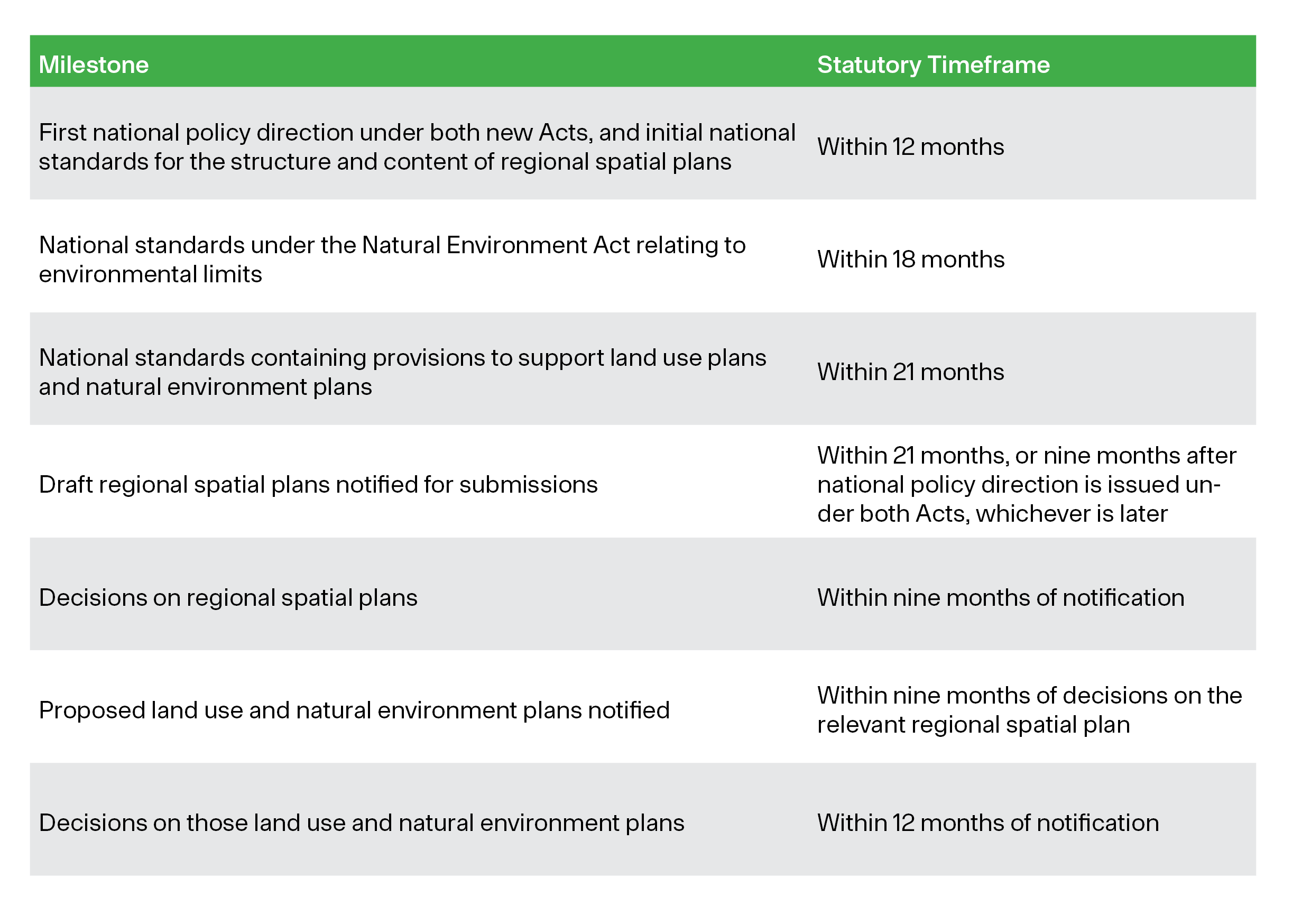
These timeframes run from Royal assent or the relevant preceding planning milestone. The overall programme will depend on the timing of national direction and progress through the planning processes.
When does the RMA stop applying?
The specified transition date is the point at which the new system takes over from the RMA. It will be set by Order in Council once the required regional spatial plans have been decided and the relevant land use and natural environment plans have been notified.
On the specified transition date for the relevant region or area:
- The new legislation replaces the RMA system, subject to transitional and savings provisions that preserve the RMA for specified applications and processes.
- Rules in notified proposed land use plans and natural environment plans will take legal effect. Plans that meet the statutory requirements for becoming operative will become operative.
- Existing RMA approvals, including resource consents, will generally be treated as their equivalent approvals under the new system.
The Acts also allow transition dates to be set for different regions, provided the required planning documents are sufficiently advanced for the areas concerned. This gives the transition some flexibility if regions progress at different rates.
Most projects will continue to work through RMA processes during the transition subject to amendments that took effect from 30 October 2026. Two changes are particularly relevant to resource consent applicants: additional procedural principles and limits on the matters councils can consider. We’ve written a separate article that covers the details of those immediate amendments. Read More
Can provisions from the new system affect RMA decisions?
Generally, provisions prepared for the new system will not be taken into account in RMA decisions during the transition. There are, however, two important exceptions.
Initial national standards can introduce new requirements while the RMA still applies. Once in effect, they must be considered in relevant consent processes and may override inconsistent RMA plan rules.
Decided regional spatial plans will also become relevant. Councils must consider whether resource consent decisions are consistent with the relevant plan. Relevant future development strategies may matter before regional spatial plan decisions are made.
These links between the two systems mean clients should watch the content of new national direction and regional spatial plans even while their applications are still being considered under the RMA.
What happens to existing consents?
Existing resource consents, designations and other approvals will continue during the transition.
At the specified transition date, current RMA approvals will generally be carried into the new system as equivalent approvals.
Many expiring consents also benefit from extensions. The Planning Act provides for qualifying consents to continue until 24 months after the specified transition date.
Water-related consents remain subject to a maximum total duration of 35 years, and wastewater-network consents are excluded from this particular extension provision.
The extension rules need to be checked against the individual consent, including its activity type, expiry date and any applicable limits. Consent holders should confirm their position before relying on an extension or deciding when to apply for a replacement consent.
For clients and project teams, the practical step is to keep a clear record of lodgement dates, consent expiry dates and the rules that apply to each approval. Those details will determine how the transitional provisions affect an individual project.
Other changes during the transition
Restrictions on plan changes, including private plan changes
The existing restrictions on preparing or changing RMA plans, often called the Plan Stop, will continue until the specified transition date. From 1 January 2028, these restrictions will also apply to private plan changes.
Enforcement changes
Some enforcement changes will take effect during the transition. These include a power for the Environment Court or District Court to make an adverse publicity order.
A new Planning Tribunal is also expected to begin operating in 2027, dealing with specified administrative decisions relating to resource consents and designations.
What should property owners and developers do now?
RMA reform makes early planning advice valuable, particularly where a project involves multiple approvals, expiring consents or a proposed change in land use.
Before lodging a resource consent application:
1. Confirm the approvals your project needs. Identify the relevant district and regional consent requirements.
2. Check the transitional rules. Establish which amendments apply to your application and decision process.
3. Review any out-of-scope matters. Keep the assessment focused on effects the council can legally consider.
4. Record key dates. Keep clear records of lodgement dates, consent expiry dates and project milestones.
5. Monitor emerging plans and standards. Identify changes that could affect your site, infrastructure requirements or development options.
The right approach will depend on your project, location and existing approvals.
Talk to Inovo about resource consent applications and RMA reform
If you have questions about the reforms or would like to understand how future spatial planning processes may affect your property, get in touch with Inovo's planning team. We can assist you to review emerging regional spatial plans, identify opportunities and constraints, and prepare submissions where appropriate. We will continue to monitor the reform programme as it evolves.
Prepared by Clara Casaes, Resource Management Planner, and Jono Begg, Resource Management Planning Team Manager. Published on 30 October 2026.

This article contains general information and opinion based on our expertise. It is provided free of charge and does not constitute legal advice.
Have you got further questions about this topic or our other services? Our full planning team is always happy to help – drop us an email planning@inovo.nz, or phone us on 020 4000 0294.